server
A static web server for a single-page app, in one Node file, with nothing to install.
- Simple setup —
npm start. No build step to run, no config file, nonpm install. - No npm dependencies —
node:http,node:fs,node:zlib. Not for running, building or testing. - 100/100 Lighthouse out of the box — every category, mobile and desktop, measured against the real server.
- A PWA that updates itself — versioned precache, offline shell, update prompt, installable.
- Does what a static host does — safe paths, brotli, typed caching, ETags, SPA fallback, security headers.
- Agent friendly —
AGENTS.md, a skill, one command that verifies everything.
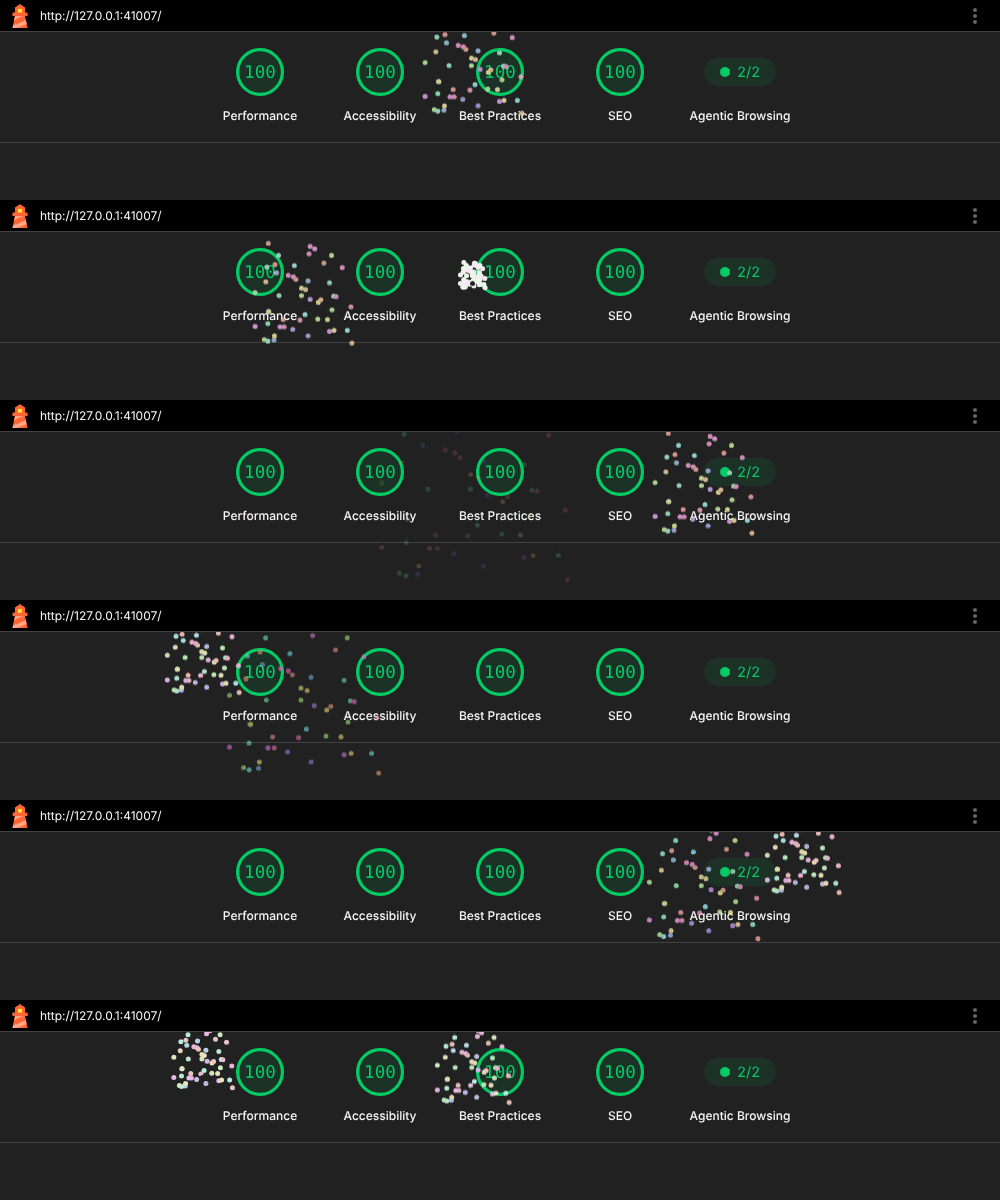
Live at server.herton.work — that copy is GitHub Pages serving public/, so the
live-status panel says so; clone it and npm start to see the server itself answer.
Run it
git clone https://github.com/hertonwork/server.git
cd server
npm start            # → http://127.0.0.1:2211
Put your app in public/. index.html is the shell every client-side route falls back to, 404.html the not-found
page. Everything else is an environment variable:
| Variable | Default | What it does |
|---|---|---|
PORT |
2211 |
Port to listen on |
HOST |
127.0.0.1 |
Bind address. 0.0.0.0 in a container or to reach it from another machine |
PUBLIC_DIR |
public |
Folder to serve |
VERBOSE |
off | VERBOSE=1 logs one line per request |
TLS_KEY, TLS_CERT |
key.pem, cert.pem |
When both files exist the server speaks HTTPS |
PORT=8080 HOST=0.0.0.0 npm start
npm run dev          # verbose, restarts when a file changes
npm run cert         # self-signed localhost certificate → the next `npm start` is https
npm test             # the server's tests (node:test, over a real socket)
npm run check        # tests + build + preflight + Lighthouse against this server
Behind nginx or Caddy you don’t need the certificate: the proxy terminates TLS and talks plain HTTP to 127.0.0.1:2211.
location / {
    proxy_pass http://127.0.0.1:2211;
    proxy_http_version 1.1;
    proxy_set_header Host $host;
    proxy_set_header X-Forwarded-Proto $scheme;
}
What the server does
| Safe paths | Every URL is resolved inside public/; ../, encoded dots and doubled slashes can’t escape it. Dotfiles (.env, .git) are hidden, /.well-known/ is not |
| SPA fallback | Extension-less paths (/about, /users/42) get index.html with a 200 so client-side routing works. Unknown /api/* paths and non-HTML requests get a real 404 |
| Correct types | Content-Type with charset for text, image/x-icon, font/woff2, application/manifest+json, application/wasm, … |
| Caching | HTML, sw.js and the manifest: no-cache (always revalidated, so deploys show up at once). Assets: one day. Fingerprinted assets (app.3f9c2a1b.js): one year, immutable. Weak ETags and Last-Modified → 304s |
| Compression | Brotli or gzip for text over 1 KB, Vary: Accept-Encoding |
| Range requests | <video> and <audio> seek with 206 Partial Content |
| Security headers | X-Content-Type-Options, Referrer-Policy, X-Frame-Options; HSTS when the connection is TLS |
| Robust | Malformed URLs → 400, POST → 405, a file that disappears → 404, an unexpected error → 500. Never a crash |
| Health | GET /api/health → { ok, started, uptime, requests, node } |
Use it as a module
import { createServer } from './lib/simple-server.js';

createServer({
  publicDir: 'dist',
  maxAge: 3600,
  headers: { 'Permissions-Policy': 'camera=()', 'X-Frame-Options': null },   // add one, drop one
  routes: {
    'GET /api/time': () => ({ now: Date.now() }),                           // return an object → JSON
    'POST /api/echo': (req, res) => { req.pipe(res); },                     // or write the response yourself
  },
}).listen(2211);
createHandler(options) returns just the (req, res) function if you want to mount it on your own server. All
options and their defaults are at the top of lib/simple-server.js.
The page
public/index.html is the server’s demo and the shell your app replaces: one HTML file with no request for JS, CSS or
fonts. It is built from site/ with sscss (a vocabulary of tiny utility
classes; the build generates exactly the rules the page uses, 2.5 KB) and Minim
(a 2.5 KB reactive library; the state is a JSON tag, the markup binds to it by key). On it:
- a request inspector — pick a path, the page fetches it from this server and shows the status and the headers that matter (type, caching, encoding, ETag), including what a traversal attempt gets;
- a live status panel —
/api/healthevery ten seconds: requests served, uptime, Node version; - the PWA state — service worker, cache version, network, install and update buttons.
npm run build        # site/ → public/index.html, public/404.html, public/sw.js
npm run check        # + preflight + Lighthouse (npm i -g lighthouse; CHROME_PATH if Chrome isn't found)
npm run vendor       # refresh vendor/ (Minim, the sscss generator, the preflight) from their repositories
npm run shots        # manifest screenshots + preview.jpg from the running server (Playwright)
npm run fireworks    # the Lighthouse report's fireworks as public/lighthouse.gif (Playwright + ImageMagick)
Every push to main publishes public/ to GitHub Pages (.github/workflows/pages.yml).
The PWA
manifest.webmanifestwith anid, maskable icon, a shortcut and screenshots — installable on Android, desktop Chrome and Edge, Safari.sw.jsis generated: its version is a hash of every file it precaches, so a deploy that changes something is a new cache and one that changes nothing leaves installed workers alone. The shell, the not-found page, the manifest and the icons are precached; a navigation that can’t reach the network gets the shell, so the app opens offline; other files are served from cache and refreshed in the background.- When a new version is installed behind an open page, the page shows “A new version is ready — Reload”; one tap
activates it. The server sends
sw.jsand the manifest withno-cache, so browsers see a deploy at once.
For agents
The repository is laid out to be worked on by coding agents as much as by people:
AGENTS.md— the layout, the commands, and the rules that keep the project what it is (zero dependencies, nothing served outsidepublic/, never a crash, the page stays at 100).skills/simple-server/— a skill that teaches an agent to serve a project with it and to build and verify a page the way the bundled one was built.npx skills add hertonwork/server.npm run check— tests, build, preflight and Lighthouse in one command, the same thing CI runs.